


The insurance coverage business is experiencing a rising expertise scarcity. Whereas this problem has been anticipated, a lot of the dialogue on options is usually generalized to your complete workforce. However not each job will likely be impacted in the identical manner. As insurers develop, some features will want extra help, whereas others will likely be higher primed to make use of cognitive expertise, like AI, RPA and extra. This implies some jobs will likely be changed by expertise, different jobs will likely be enhanced by expertise and different jobs would require extra people (an space the place folks can shift to, if their job is changed).
The very fact is that insurance coverage operations are altering, and individuals are the middle of that change. The query isn’t, “How can we deal with this workforce hole?” The query is, “How will claims, underwriting and gross sales be impacted by this workforce hole, and the way can we leverage expertise to deal with each to enhance our operations holistically?” That’s what I’ll be exploring right here.
Urgency wanted to deal with the rising workforce hole in insurance coverage
In June 2021, the US Chamber of Commerce launched the The America Works Report with alarming statistics:
- Lower than 25% of the insurance coverage business is below 35 years outdated.
- Within the final 10 years, insurance coverage professionals aged 55 and older elevated by 74%.
- The Bureau of Labor Statistics estimates that over the following 15 years, 50% of the present insurance coverage workforce will retire.
- There will likely be greater than 400,000 open positions unfilled over the following decade.
These statistics paint a startling image—and one which requires an pressing response. However an getting older workforce isn’t the one concern:
- Insurance coverage corporations are additionally making an attempt to develop, that means they both want a bigger workforce or the power to scale with the present dimension workforce.
- Many instances, there’s a expertise mismatch the place the present insurance coverage workforce lack the talents wanted to function in an automatic and information centric surroundings.
- Whereas insurance coverage corporations don’t all the time want a whole lot of elite tech engineers, they do want their fair proportion of foundational and complimentary technical specialists, particularly because the give attention to AI/ML and the cloud continues to extend. This will create expertise competitors with massive tech corporations that provide increased salaries, extra perks and extra modern work.
Tackling the workforce hole holistically
Realistically, the business will be unable to switch 400,000 open positions one-to-one. And even when it did, the quantity of information loss with 50% of the workforce retiring is big. That is the place cognitive expertise is available in as a part of the answer.
It’s vital to emphasise that expertise is just half of the workforce hole answer. Whereas extra administrative, redundant duties will be automated, different features might have extra folks (like sales-related areas, which I’ll discover intimately later).
Insurers must do two contradictory issues on the identical time: Take a look at their workforce individually and holistically. Choice makers must know the impression of the workforce hole and the supporting applied sciences for every particular person job perform. However since jobs don’t function in silos (no less than, they shouldn’t), insurers additionally must have a holistic understanding of how modifications will impression the best way totally different features work together with and help one another. Finally, there is no such thing as a one-size-fits-all answer. However there are vital insights for all insurers to contemplate.
Cognitive expertise is altering the insurance coverage workforce
Cognitive expertise will impression totally different jobs in numerous methods. Some jobs will likely be changed by automation; others will likely be augmented by expertise; and different jobs might want to develop the human workforce in tandem with expertise.
Earlier than leaping into particular job features, it’s vital to know the varieties of expertise which can be changing into increasingly more ubiquitous. The next desk highlights the expertise P&C insurers are specializing in in 2022.
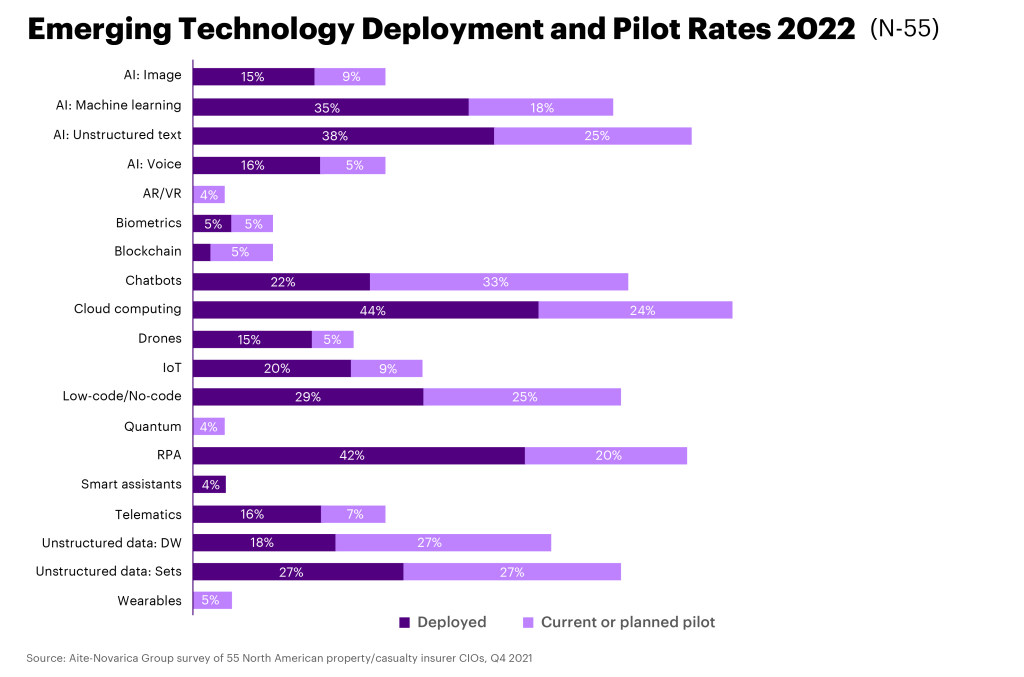
Clearly, AI, information and RPA are main areas of focus. Chatbots are additionally getting used extra usually to enhance customer support, whereas cloud and information stay key areas for operational efficiencies and insights. Every of those applied sciences will impression jobs in numerous methods. Let’s discover.
The importance of partnerships
A fast notice on the significance of partnerships: You’ll discover all through the examples beneath that just about each certainly one of them is achieved through a partnership. With tech expertise changing into more durable to search out, partnerships will likely be a key technique to bridge the expertise hole and implement complicated expertise at scale—and shortly.
The future of claims: Replace and augment
To deal with the workforce hole in claims, expertise will likely be used to each substitute and increase staff, although the size of this impression will likely be totally different between private and industrial strains.
Private:
Private claims is probably the most liable to automation, particularly for easy claims. A small car parking zone automobile accident is an ideal instance of a simple sort of declare that AI can deal with—with human spot-checking, in fact.
Actual-life tech instance: Hippo not too long ago partnered with Claimatic and 5 Sigma to make use of automation to course of owners’ claims quicker and handle them end-to-end. From a buyer perspective, this presents a single level of contact, quicker response instances and simpler claims monitoring. From an operations perspective, this automation reduces back-end friction and ensures accuracy by figuring out the severity of a declare and flagging when a loss is recognized.
Worker impression: There’ll doubtless be an worker scale-down of the claims workforce as automation manages extra of the claims course of. On the identical time, remaining staff will likely be augmented with expertise to assist them to handle claims quicker and extra precisely. Trying on the Hippo instance, a part of its new automation expertise is to match claimants with adjusters—a sometimes handbook, time-consuming course of. This augments the claims workforce in order that they’ll keep away from some of these administrative duties and give attention to what issues: the client.
Industrial:
Like private strains, industrial claims departments will likely be each changed and augmented by cognitive expertise, however at a distinct price. Industrial claims are sometimes extra complicated, so there will likely be extra augmentation versus alternative, in comparison with private strains.
Actual-life tech instance: Protecting insurance coverage partnered with Roots Automation to scale its trucking and industrial auto insurance coverage claims. In solely 4 months, Protecting launched two “digital co-workers” referred to as Roxy (for sending letters to claimants) and Rex (for indexing claims paperwork). Each bots have been capable of full 95% of duties with out human intervention.
Worker impression: Most claims staff working in industrial strains will likely be augmented by cognitive expertise. The Protecting insurance coverage instance reveals how bots will be leveraged to handle probably the most time-consuming duties, like indexing paperwork. This frees up staff to give attention to extra vital duties or deal with extra claims. That is particularly vital for the underserved small-to-medium enterprise (SME) market. By streamlining industrial claims as a lot as potential, the SME market might look extra enticing to insurers.
The way forward for underwriting: Increase
Underwriting encompasses each threat evaluation and product growth. This can proceed to be a key space for insurers to stay trendy and aggressive, so headcount will doubtless not be reduce. Nevertheless, individuals are retiring. Insurers should ask themselves: Can we substitute retiring employees or use expertise to scale up our present workforce? With the present expertise hole, that latter is extra sensible. This implies underwriting is transferring right into a world of semi-automation, each for private and industrial strains. And meaning re/upskilling.
Actual-life tech instance (private): Product growth is a big a part of underwriting, and quite a lot of insurers are leveraging cognitive expertise to make the correct merchandise on the proper time. Arbol partnered with RealTimeRental to supply real-time parametric climate safety for trip leases utilizing AI, analytics and third-party information. AXA Life & Well being Reinsurance Options makes use of a white-labeled model of Verisk’s Well being Danger Score Software they’ve branded because the Clever Medical Acceptance Software (IMPACT) to automate components of the medical insurance underwriting course of to allow higher protection for purchasers with pre-existing circumstances.
Actual-life tech instance (industrial): On the industrial facet, threat is the core theme for cognitive expertise. Allianz SE partnered with Cytora to faucet into AI-based threat processing for its industrial strains enterprise, permitting underwriters to give attention to value-adding duties. One other instance is insurtech Neptune Flood, which developed an AI-based ranking and quoting platform for automated threat evaluation. With this expertise, Neptune noticed 400% progress and is now the most important personal flood MGU within the US.
Worker impression: Expertise is already altering underwriting, particularly from a product growth and threat evaluation standpoint. Reskilling the workforce will likely be essential. Expertise, particularly the power to ingest third-party information leveraging the power of the cloud, could make product growth quick and nimble. Employees might want to really feel comfy trusting new information sources and AI to drive innovation. Taking a look at threat evaluation, a human perspective will all the time be vital. However underwriters will be knowledgeable and supported by AI and different cognitive expertise to enhance accuracy and make higher choices. Workers will should be reskilled to modernize their strategy and reap the benefits of the large-scale evaluation supplied by AI and different applied sciences.
The way forward for gross sales: Increase and develop
It’s not stunning that gross sales and its related features, like advertising and marketing, might want to scale with digital tech. Gross sales should get extra modern as competitors grows and prospects demand a seamless expertise. New areas, akin to embedded insurance coverage, will leverage expertise and technique in a manner the business has by no means finished earlier than. To help this speedy shift and progress, gross sales features might want to broaden whereas additionally being augmented with expertise.
Actual-life tech instance (private): Direct Auto & Life Insurance coverage selected Advertising and marketing Evolution’s buyer journey monitoring answer. This persona-based advertising and marketing measurement and optimization platform will present insights into the touchpoints prospects interact with alongside their path to buy. These insights will assist Direct Auto & Life Insurance coverage to higher perceive its prospects, ship a customized expertise and critically—the way to hyperlink habits to gross sales.
Actual-life tech instance (industrial): Nationwide expanded its relationship with Amazon Net Providers to innovate and deploy modern merchandise whereas in addition they streamlined inner operations. From a gross sales industrial perspective, this partnership helped Nationwide construct a Small Enterprise Advisory platform that makes use of machine studying to tailor customized insurance coverage coverage suggestions to small enterprise prospects in minutes.
Worker impression: Gross sales, advertising and marketing and buyer engagement are essential for progress. Workers in these areas will likely be augmented with expertise, whereas groups broaden headcount. To stay aggressive, insurers might want to innovate and construct a enterprise growth ecosystem. Expertise by itself received’t do that. Like underwriting, cognitive expertise will supply the instruments for inventive salespeople to innovate—and the client insights to make data-driven choices and promote progress.
Roadmap to the longer term: A cross-functional perspective
As I discussed earlier than, job features don’t function in silos. So, this breakdown will get extra difficult once we take a look at how every perform interacts with one another. For instance: Claims and underwriting are intertwined. Modernizing claims to higher leverage the info utilized in underwriting and vice versa is extra vital than ever. Breaking down these silos will drive an enterprise stage change in behaviors and collaboration.
That’s why insurance coverage corporations must take a cross-functional perspective when figuring out how expertise will change their workforce. And this shouldn’t be a theoretical technique.
How you can use tech to shut the insurance coverage workforce hole
Insurers ought to put collectively a concrete workforce roadmap. The roadmap needs to be modular, outlining which areas will want new hires versus reskilling. It ought to think about the interplay between features and the way altering one will impression the opposite. It must also point out the place folks will be moved round to capitalize in your present workforce and the information and expertise that they’ve.
One other key component of evolving your workforce is early inclusion. Workers deserve transparency in the case of how their jobs will change. Early involvement will assist staff really feel like they’re part of that change—and decrease alternative fears. As a result of all of the roadmaps on the planet received’t assist if staff really feel threatened and reject change. Insurance coverage corporations can keep away from this by being supportive, trustworthy and by listening.
Whereas a roadmap and transparency are vital from an worker perspective, the expertise facet is its personal area. This weblog appeared on the product and repair facet of the insurance coverage workforce, however implementing cognitive applied sciences requires a proficient, motivated IT staff. Insurers might want to marry a tech roadmap that aligns with its workforce imaginative and prescient utilizing agile methodologies to permit for flexibility and pivots, if wanted. Critically, executives want to have the ability to talk this holistic imaginative and prescient throughout the group—together with tech companions.
The insurance coverage business has a tricky highway forward in the case of expertise. Many years’ price of information is about to be misplaced to excessive retirements, and youthful generations aren’t banging down the door to work in insurance coverage. Carriers might want to get inventive utilizing a mixture of expertise and a reskilled human workforce to shut this hole and drive future progress. The time for this transition is now, or else you threat falling behind. Simply do not forget that staff are folks—deal with them with respect and compassion, and they’re going to rise to your expectations. As we are saying at Accenture: Innovation occurs the place expertise meets human ingenuity. The insurance coverage business will want each to reach the longer term.

Remodeling claims and underwriting with AI: AI has emerged because the essential differentiator within the insurance coverage business when utilized in tandem with people.
Get the most recent insurance coverage business insights, information, and analysis delivered straight to your inbox.

